Delivering consistently high-quality training is key to a successful apprenticeship programme, but it takes time, effort – and money. If you...
Last updated August 12, 2026
In this article: The State of the Skills Sector 2026 reveals confident providers facing big choices on employer demand, young people and AI | 9 minute read.
You don't need to spend long in funded learning to know that optimism is handed out lightly. So the findings from Bud and AELP's State of the Skills Sector 2026 report deserve attention.
The research asked providers about their performance today, the pressures shaping their plans, and where they expect to invest and grow over the next two to three years. What emerged was a sector feeling confident in its own capabilities, but far less certain about the environment around it.
More than four in five respondents (81%) described their organisation's performance as good or very strong. Nearly three-quarters (72%) were confident about their future prospects, 54% said their financial position had improved over the previous 12 months, and 62% expect apprenticeship delivery to grow over the next two to three years.
So this is not a sector waiting for stability before it takes steps: providers are delivering, adapting and planning for growth now, which deserves acknowledgement given the conditions they have been navigating.
There was no blind optimism; the same respondents were unguarded about the pressures they face: 72% named policy uncertainty as a major challenge, 69% disagreed that current funding supports sustainable delivery, and only 15% felt the policy environment provides enough clarity for long-term planning.
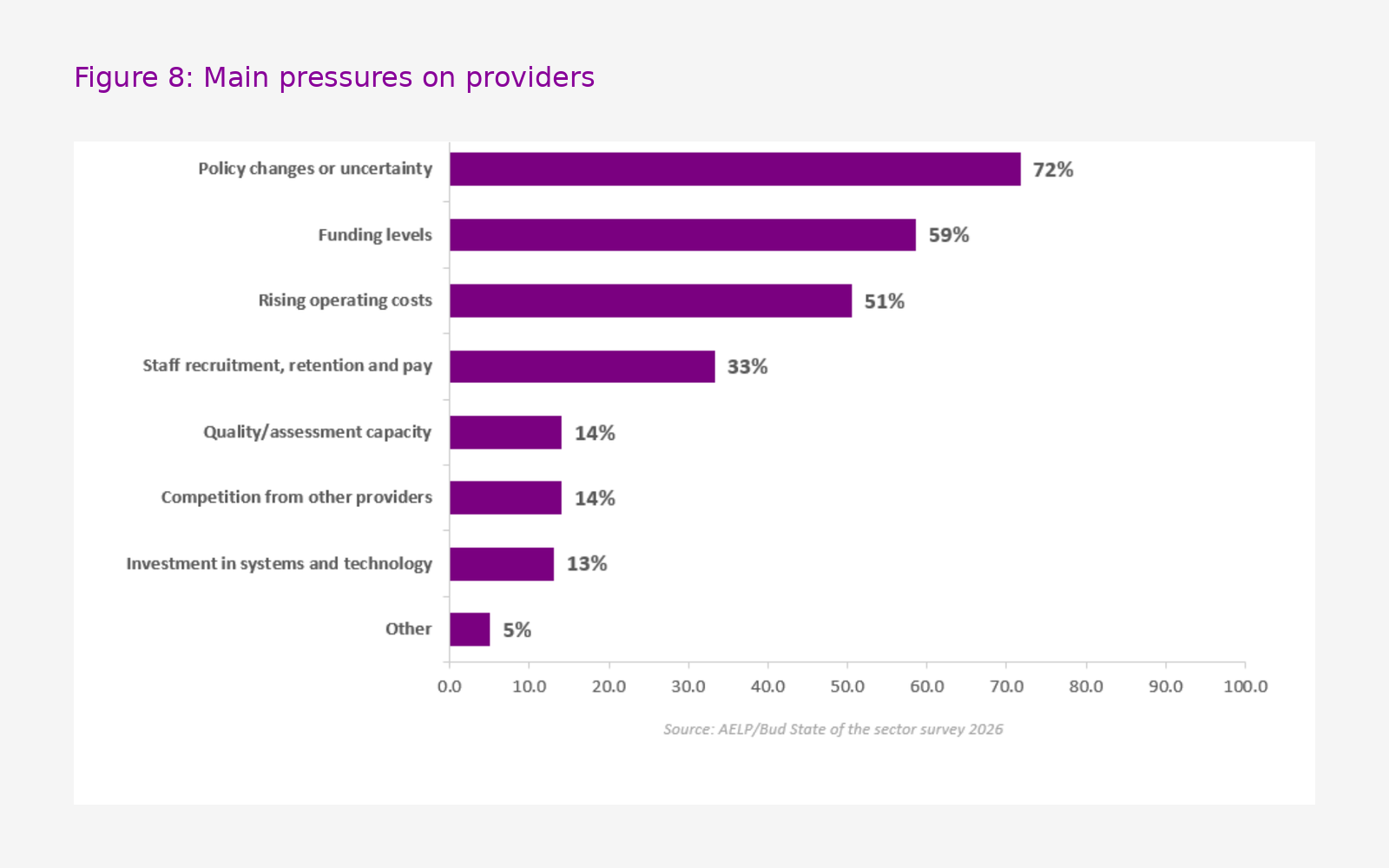
Put those two sets of findings together and the picture becomes interesting. Providers have considerably more faith in their own people and delivery than they do in the policy environment around them. They also believe they can respond to change, even when it is still difficult to see exactly what shape that change will take.
Confidence isn't the same as complacency
Of course, change is nothing new for the skills sector. New funding rules, policy priorities, programmes and expectations are hardly unusual, and providers have become very good at absorbing them while keeping learners and employers moving.
There is a danger, though, in celebrating that resilience as if uncertainty doesn’t carry a cost to providers. Recruiting specialist staff, investing in systems or entering a new market all require a sensible view of demand and enough certainty to commit. Major decisions cannot remain provisional indefinitely.
Even so, the report’s findings do not point to a sector paralysed by what it cannot control. It describes organisations with experience, delivery capability and an appetite to grow. The question we’re asking now is how providers can use that strength as some of the biggest opportunities that lie ahead are still taking shape.
Young people are not simply 'the next growth market'
The scale of one of those opportunities is difficult to ignore. The Milburn review’s interim report Young People and Work estimates that almost one million 16 to 24-year-olds across the UK are not in education, employment or training. And the renewed national focus on participation, work experience and routes into employment is plain to see – just a couple of weeks ago, government announced full apprenticeship funding from August for all eligible under-25s, additional financial support for SMEs hiring young apprentices, and the introduction of a new bursary to support Universal Credit families for whom financial barriers are an obstacle for young people looking to take up apprenticeship opportunities.
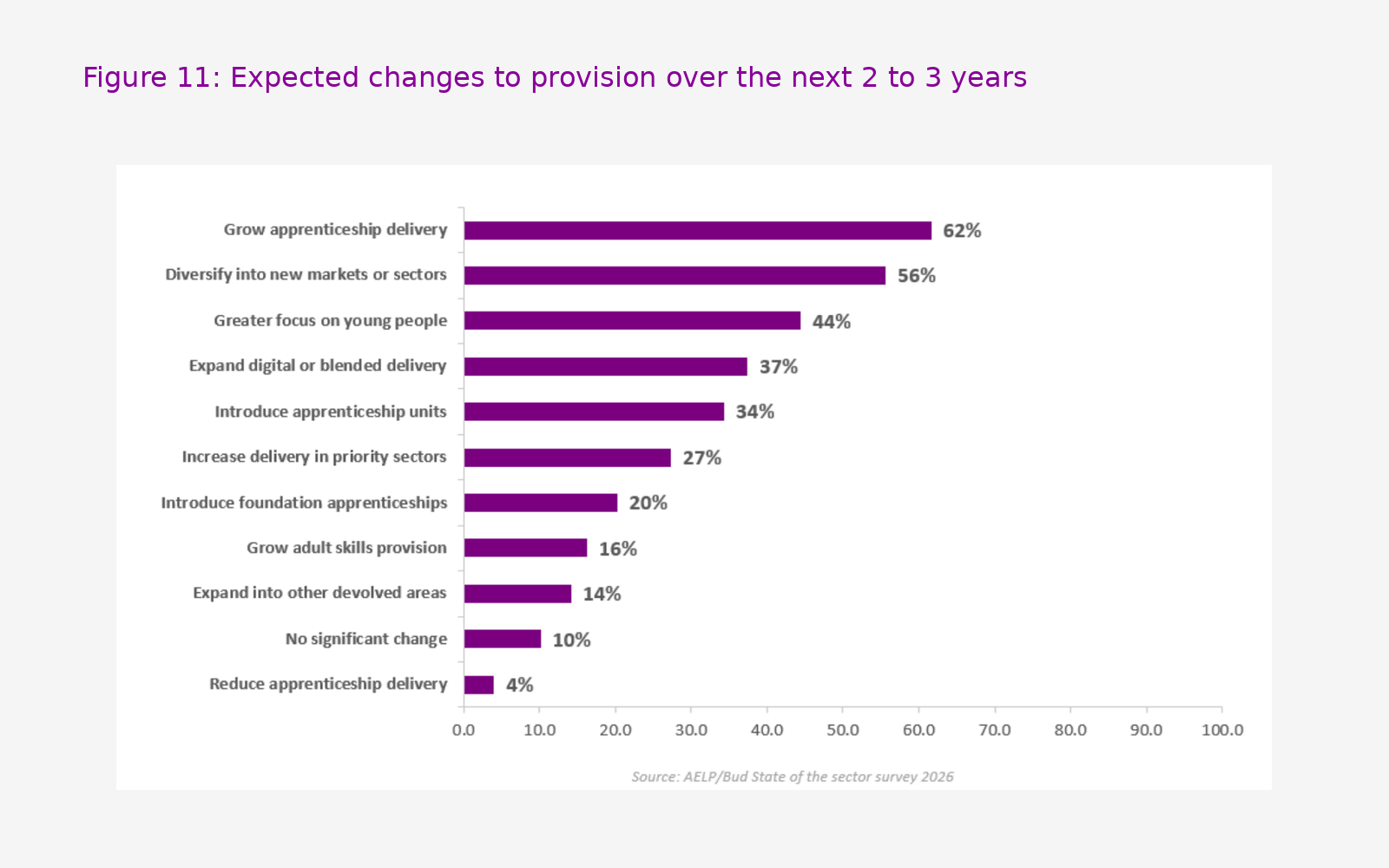
Against that backdrop, it’s unsurprising that 44% of survey respondents expect a greater focus on younger learners over the next two to three years, with 20% expecting to introduce foundation apprenticeships.
The easy conclusion would be that providers need to move faster, but that’s very simplistic. As we’ve explored in our work on flexible delivery and learner success, flexibility only creates value when the delivery model around it is strong enough to support it, and the same principle applies here: ambition matters, but so do having the practical conditions in place to make high-quality provision possible.
There is a significant opportunity for the sector to enable more young people to progress into sustainable work. But realising it will take the right providers, viable funding models, willing employers and delivery models designed around actual skills needs – which brings us to aligning our provision with employer demand.
Employer demand has to shape the routes we build for young people
There’s no shortage of growth ambition; nearly two-thirds of surveyed respondents (62%) expect their apprenticeship delivery to grow, 56% expect to diversify into new markets or sectors, and employer engagement and growth was the most frequently selected investment priority.
Then comes the misalignment: only one in five respondents felt that current provision was aligned with employer demand.
Employer demand is not the part that needs to align with existing provision. The responsibility runs the other way. Providers need to understand how roles, technologies and working practices are changing, then decide where and how their provision should respond.
Providers are not short of employer contact, but contact is not necessarily helpful intelligence here. A hundred useful conversations will have limited strategic value if what employers are saying stays in individual inboxes, meeting notes or people's heads.
The State of the Skills Sector report can’t tell us how consistently employer insight is being captured, or how often it changes provision decision. But it does leave us with some important questions: Are providers hearing changing workforce needs early enough? How do they distinguish one-off requests from wider industry patterns? And is that influencing what they deliver, where they recruit and what they build next?
AI has the sector’s attention, but what are providers doing with it?
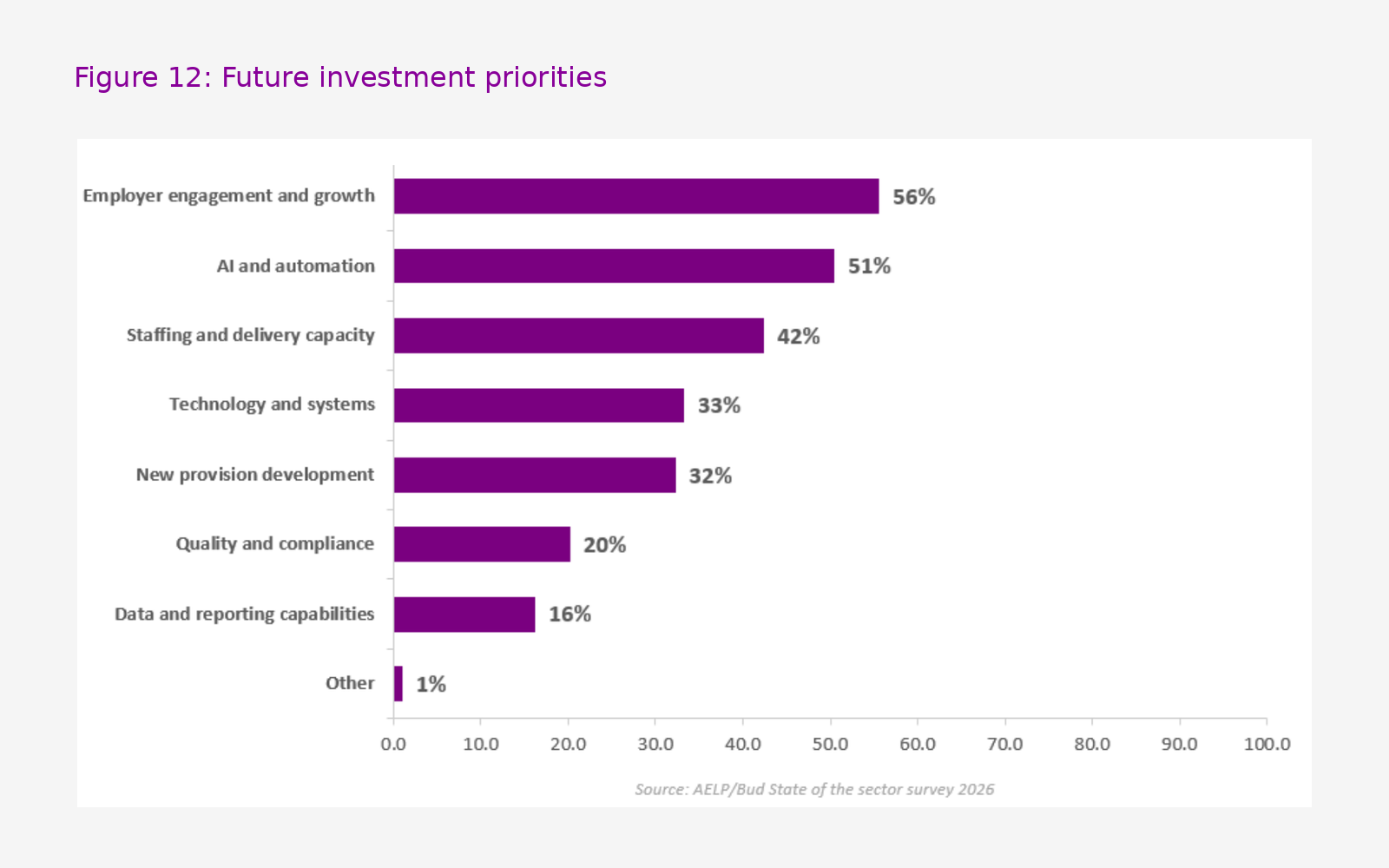
AI and automation was the second most frequently selected future investment priority in the survey, chosen by 51% of respondents.
That’s significant, but it isn’t a landslide. Almost half of providers didn’t select it, and the survey doesn’t tell us why. Some may already have invested, while others are likely to be focused on more immediate priorities uncovered in the report.
The report certainly doesn’t evidence a sector rushing headlong into AI, but it also doesn’t tell us that the other 49% are ignoring it.
What it does tell us is that AI is now firmly on the sector’s strategic agenda, at a time when providers are thinking seriously about growth opportunities and change. Some 62% expect apprenticeship provision to grow, while 56% anticipate diversifying into new forms of provision.
This wider context of growth ambition and diversification creates operational questions: how providers can increase capacity without losing quality, respond more quickly to changing employer needs, and give learners and staff the right support. AI won’t answer those questions on its own, but is increasingly becoming part of the response.
With 33% of survey respondents selecting technology and systems as a future investment priority, and 16% selecting data and reporting capabilities, it raises an important question: are organisations considering the data architecture, systems and processes any future AI capability will depend on?
Because AI investment and AI readiness aren’t the same thing.
The sector already holds the most important part of the equation: deep expertise in learners, employers, funding and delivery. The strategic decision isn’t simply whether to “invest in AI”. It’s whether providers are beginning to understand where it could make a genuine difference, and building the confidence to make informed choices about it. That means starting with the work rather than the technology.
A sector with choices to make
A pulse survey of 120 organisations doesn’t produce a universal playbook for a sector as varied as ours, but our hope is that the report gives providers a credible point of comparison, as well as bringing to light some of the more important choices they have ahead of them.
There is plenty in the State of the Sector findings for providers to feel positive about; the report illustrates a sector that is confident in its capabilities, ambitious for growth and aware of the changes ahead. The question now is how to turn that confidence into well-judged decisions: which opportunities are right for the organisation, what may need strengthening and where providers are best placed to make a difference.
The full report explores the evidence in more detail. In our follow-up webinar, we’ll look at what it means in practice: how providers can respond to the findings, assess their readiness and decide where to start.
Download the full State of the Skills Sector 2026 report
The report contains the full survey findings, charts and provider commentary across organisational performance, policy and funding, apprenticeship reform, employer demand, young people, technology and AI. Download the State of the Skills Sector 2026 report.
On 13 August, AELP's Neil Anderson and I will explore what providers do with those findings: the choices they raise, what readiness looks like in practice and where it is sensible to begin. Register for the AELP webinar.
Related resources

Last updated June 26, 2023
.png)
Last updated January 21, 2025
The Department for Education (DfE) will be looking at a number of critical factors during their apprenticeship audits, but these aren’t alwa...
Last updated July 10, 2026
Press Release: Bud’s new capability gives learners a first line of support built around their own learning plan. | 5 minute read. Bud, the a...