In this article: Why learner progress depends on earlier, more responsive programme design. | 9 minute read.
When a learner’s attendance drops, their progress slips or they miss a deadline, we tend to say they are “falling behind”.
“Falling behind” is a familiar, convenient phrase that places the learner at the centre of the problem. They have lost momentum, they have failed to engage or they have not kept pace with the programme. The provider’s role is then to intervene and help them catch up.
But what if the learner did not suddenly fall behind?
What if the journey had been leaving them behind for weeks or even months before any of us noticed?
Learners very rarely fall behind in one single, identifiable moment. It’s much more common for progress to be lost gradually, when the support available is failing to adapt to any given learner’s emerging needs. By the time their attendance or progress data turns red, the underlying issues are likely to be several weeks old.
Why progress data can identify learner risk too late
Providers hold more information about learner progress than ever before. Attendance, activity completion, off-the-job hours and progress against plan all help to identify where attention is needed.
The difficulty is that many of these measures tell us what has already happened.
A missed monthly session could be the first visible sign of disengagement, but the learner’s confidence may have been declining since the previous session. An overdue activity may appear as a red indicator today, even though the barrier preventing its completion emerged several weeks ago.
In recent closed executive operator forum discussions run by Bud with senior leaders across funded learning, this tension surfaced repeatedly. Providers have growing volumes of learner data, but the indicators that actually command attention can still appear after the opportunity for simple, preventative action has passed.
These conversations raised an important question: are we identifying learner risk, or documenting it once it has already become visible?
By the time such information reaches decision-makers, the response is often urgent: additional calls, recovery plans, employer conversations and intensified tutor contact.
All of that takes time and resource. More importantly, it asks the learner to recover from a situation that might have actually been preventable.
How initial assessment should shape the learner journey
Initial assessment is often treated as a gateway: a process that establishes eligibility, prior attainment and whether someone is suitable for a programme.
But suitability works both ways.
We ask whether the learner is right for the programme. How often do we ask whether the programme, as designed, is right for the learner?
Two people applying for the same apprenticeship. One has strong GCSE results but little practical experience and low confidence. The other has lower grades, but relevant work experience, strong communication skills and a clear occupational motivation.
Which learner is more likely to succeed?
The answer depends partly on what your initial assessment values. If it mainly measures English, maths and prior academic achievement, it may identify the first learner as the stronger candidate. It could miss the practical knowledge, confidence and occupational behaviours that make the second learner brilliantly suited to the programme.
And it’s in this way that entry criteria can so easily become entry restrictions. They can protect a straightforward delivery model – excluding those who would succeed with an adjusted route and the right support.
Initial assessments should do more than establish starting points, they should influence the learner’s curriculum, contact pattern, early support and first review.
If we are identifying needs but not actually making changes, we are not removing barriers, we are only documenting them.
Why consistent standards do not require identical learner journeys
Of course, consistency matters in apprenticeship delivery. Learners should be working towards the same ambitious occupational standard, and providers need a delivery model that can deliver this, effectively, at scale.
But consistency of outcome does not require uniformity of journey.
One learner may benefit from shorter, more frequent contact with their tutor during the first months of their programme. Another may need greater stretch and challenge to remain engaged. Yet another may need adjustments put in place following a change in their personal circumstances.
And none of this needs to mean that we lower expectations.
It means separating the standard from the route.
The destination remains the same, but the support, pace and touchpoints can adapt. And that adaptability does not always require more contact overall – two hours of monthly tutor contact might mean one two-hour session for one learner but become weekly thirty minute check-ins for another.
And don’t forget, you are likely often already investing this additional time – but are you currently investing it too late, only after a learner has gone ‘off-track’ and you’re trying to recover their progress? What would change if more of that effort moved to the beginning?
What a responsive learner journey can look like
A responsive learner journey connects four things:
- Starting point: What does the learner already know, what support might they need, and what could obstruct progress?
- Adaptation: What changes in the curriculum, contact pattern or support as a result?
- Intervention: Which early signals should trigger action, and who owns the response?
- Impact: Did the adjustment improve progress, confidence, retention or achievement?
The connection between these stages actually matters more than any individual process.
Good initial assessment without adaptation is just administration. Data without agreed intervention is simply reporting. Support without an assessment of its impact can become a permanent label rather than a responsive part of the learner journey.
Some learners will require more intensive input from the outset. Others may begin confidently but experience a change midway through their programme. Support should be able to increase, reduce and increase again as circumstances change.
And crucially, those decisions need to be visible. Providers should be able to see what prompted an adjustment, what changed, whether it worked and why support was strengthened or stepped down.
Otherwise, effective practice may remain dependent on individual tutors’ professional judgement, without the wider organisation being able to learn from it.
As most of us realise by now, the current further education and skills inspection toolkit evaluates inclusion at whole-provider level and focuses on the impact of the systems leaders use to support improvement. Inspectors primarily seek evidence of how a provider normally operates, rather than documents created specifically for inspection.
That makes your evidence trail important, but not just for inspection. It should help providers understand whether their support is genuinely changing outcomes.
Why achievement rates should be reviewed in the context of access and retention
We should celebrate improved achievement rates, but we should also recognise that achievement alone doesn’t tell us whether a programme has become more inclusive, whether delivery has improved for comparable learners or whether the profile of the learner cohort has changed, and all three of those things will affect the numbers.
So we challenge leaders who aren’t already doing so to review achievement alongside access, early withdrawals, retention and outcomes for learners with different starting points. This doesn’t undermine positive results, it helps you understand what produced them.
Consider:
- Did access remain open?
- Did retention improve alongside achievement?
- Did learners with different starting points progress in line with their peers?
- Can we show that earlier support changed outcomes?
- Who is still missing from our strongest results?
And it’s particularly important at a time when nearly one million young people aged 16 to 24 are not in education, employment or training. The interim Milburn report describes a wider crisis of detachment from education and employment, with potentially lasting consequences for young people and the economy.
Providers can’t solve the NEET crisis alone, but they can examine whether their entry decisions, curriculum structures and learner journeys truly open doors or quietly narrow them.
In summary: The learner should not have to become a problem to receive support
A responsive learner journey doesn’t wait for ‘failure’ and then react.
Initial assessment helps shape the programme and the learner contact points, and delivery is continually adapted based on tutors’ insights into learner needs.
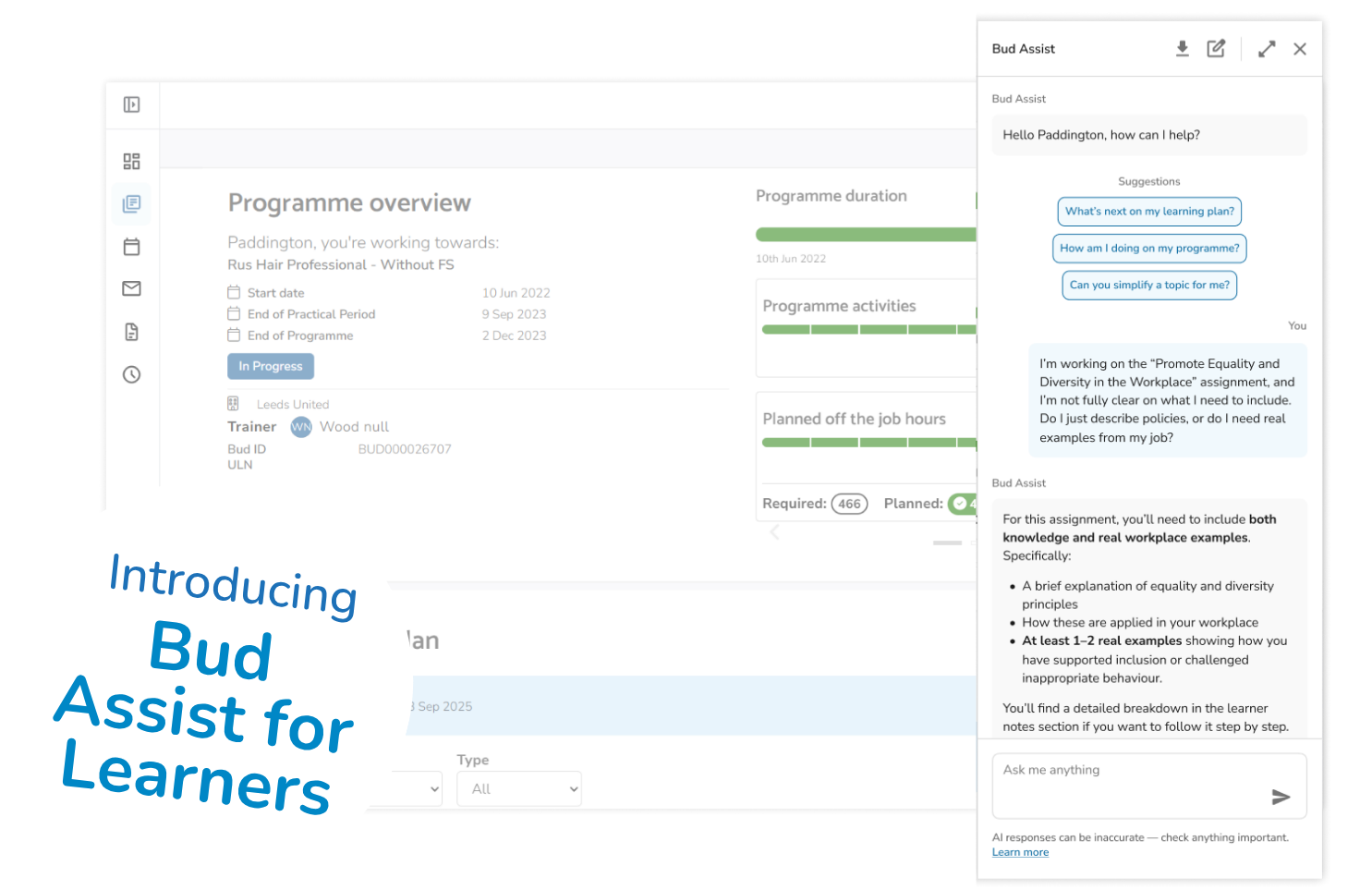
Bud’s apprenticeship training platform connects delivery, progress and reporting data across the learner journey, helping providers develop a clearer view of where action is needed. Learner progress reporting shows when learners are ahead or behind against activities and off-the-job hours, helping teams identify where additional support, stretch or challenge may be appropriate.
Technology itself cannot decide what meaningful intervention looks like. But at Bud, we’re working to make the relevant signals more visible, connect information that might otherwise sit separately and help teams act before a temporary barrier becomes a lasting gap.
Because the learner should not have to become a problem before they receive the right support.