In this article: Why AI governance matters in the skills sector, and how providers can innovate responsibly with clear oversight, auditabili...
Why the skills sector needs to treat AI like the workforce shift it actually is

Last updated July 9, 2026
In this article: AI in the skills sector is no longer just an efficiency tool, but a shift in how provider organisations apply intelligence, scale expertise and rethink the role of technology in apprenticeship delivery. | 11 minute read.
Ask any leader in the skills and apprenticeship sector how they’re currently using AI, and you’ll either hear ‘we’re not sure, yet’, or a familiar list of efficiencies – summarizing policy documents, drafting enrolment emails, and generating first drafts of new course content to name a few.
These are real and valuable use cases. They save time, reduce the burden of administration for providers, and help overstretched teams move faster.
But they’re also – by the standards of where AI capability currently sits in summer 2026 – remarkably modest.
The current mental model for AI in our sector – as a tool you pick up only when you have a specific task – is already several years out of date. AI technology has shifted from "search and respond" tooling to something far more significant, and the chasm between how it’s currently being used by organisations and what it’s actually now capable of is not a technology gap but a conceptual one: The technology has moved on, but our thinking simply hasn’t kept up.
Provider organisations that can start to close this gap in the next twelve months will find themselves operating at a structurally different level from those that don't. They’ll move past treating AI as a "feature" and start treating it as a teammate.
From tool to teammate: What's actually evolved?
To understand the shift, let’s be precise about the distinction between "reactive" and "agentic" AI – terms often used loosely, but the difference between them is the difference between a static library and a living workforce.
- Reactive AI: Your all-knowing yet passive research assistant
The AI we’re all familiar with, and what we see most current training and education use cases working with. Reactive AI waits for a prompt, and answers when asked.
A learner submits a question; the system responds. A tutor asks for a summary; the system provides it.
While undeniably helpful, reactive AI has no memory of what happened yesterday and no eye on what might happen tomorrow. It’s a capable research assistant, but it is fundamentally passive.
- Agentic AI: Your proactive new team member
Agentic AI, by contrast, works on your behalf across time. It pursues the objectives you set it across multiple steps, making judgements and maintaining context over time. Agentic AI adjusts course when circumstances change, even when you’re not in the room.
Speaking at the AELP National Conference, Bud CEO John Ingram described the distinction well: "A reactive tool is a capable research assistant – useful when you ask it something. An agentic system is more like an additional team member – one who is working on your behalf, across your whole caseload, even when you're not in the room."
This isn't an incremental upgrade; it is a structural change. It moves AI technology from being a system that responds to one that monitors continuously, and that fundamentally changes which problems it can solve.
The problems to solve in apprenticeship delivery
The hardest challenges in apprenticeship delivery are rarely "single-question" problems. They don’t arrive neatly, asking to be solved in one moment. Instead, they are sustained, multi-step challenges that play out over weeks or months, often invisibly, until they come to a head.
Consider the quiet signals that might currently slip through the cracks of a busy tutor’s schedule:
- The gradual disengagement: A learner doesn't stop working overnight. Instead, they become slightly less responsive over the course of multiple weeks. Their submissions get a little shorter; their reflections start to show less enthusiasm; they begin to skip optional activities. In isolation, none of these signals feel urgent, but together, the pattern tells a story of a learner who is at risk of dropping out.
- The compounding knowledge gap: A concept that hasn’t quite been understood in month two can quietly become a structural weakness by month eight. By the time it's discovered during a review, the knowledge gap has become a major barrier to the learner’s progress that is now much more complicated to remedy.
- The fading employer relationship: Slow replies, missed meetings, or limited feedback from an employer can quietly derail a learner’s progress. Reactive tools wait for the tutor to notice; agentic AI spots the pattern in operational data before the relationship cools entirely.
- The subtle safeguarding signal: A shift in language, tone, or subject matter in a learner’s journal might be the first sign of a mental health or safeguarding concern. A tutor with a caseload of 40 learners might not catch a slight change in tone across 30 different check-ins, but a proactive AI system monitoring the full context can.
The question of how reliably agentic AI can detect those signals depends entirely on the quality of the data it is working from, because effectiveness is not just determined by the quality of the AI tool itself. It’s determined by the quality, consistency, and accessibility of the data beneath it.
A reactive system cannot see these patterns because it only processes what it is given in the moment. An agentic system, operating on architecture that ensures it can draw on the full data context of every learner and every interaction – not just a partial view – can connect the dots. It identifies that something is about to go wrong, rather than simply telling you when it already has.
The human element: Scale expertise, don't replace it
Whenever the conversation turns to "AI teammates," concerns about tutor replacement tend to surface immediately. If AI can now monitor caseloads, flag risks, and suggest interventions, what exactly is the tutor’s role?
This is the wrong question, because it assumes that the current limitation on quality training is a lack of tutor expertise. In reality, the constraint is the structural impossibility of deploying that expertise at the scale and frequency that learners actually need.
A great tutor with a caseload of 40 or 50 learners cannot give every single individual the same depth of attention every day. That isn't a failure of care or capability, it’s just simple maths.
Extend tutor reach and protect the coaching space
Effective agentic AI will act as an extension of the tutor’s reach. It will handle the "monitoring" and the "flagging" tasks, so the tutor’s professional judgment can be focused and directed exactly where it is needed most. So instead of significant time sifting through learner communications and activities to assess engagement levels, a tutor can be prompted: "Learner X is showing signs of disengagement; here is the context you need to step in and have a coaching conversation."
Good apprenticeship and skills delivery is about so much more than just the transfer of information: it’s founded on coaching, feedback, encouragement, and challenge. AI won’t flatten that relationship, but it can protect more space for it. By automating the "chasing" and the basic information retrieval, we can free up skilled humans to do what only humans can do: make judgment calls, provide emotional support, and act on the moments that truly matter.
John Ingram was specific about what good AI-assisted learning should look like at the interaction level: "Not a chatbot that hands over answers. A system that prompts reflection, checks understanding, and flags when the coaching relationship itself needs a human to step back in."
That framing: Socratic, iterative, and most importantly, deferential to human expertise in the moments that matter, is a meaningful departure from the way AI is currently being deployed in most learning contexts.
And how we design and deploy these AI interactions is almost more important than the technology itself. No one wants a chatbot that simply hands over answers to learners – that’s a shortcut to nowhere.
Instead, AI-assisted learning needs to mirror good coaching practice and a given provider’s pedagogy. When a situation moves beyond the its defined boundaries or becomes too complex, an in-built "escalation" path needs to bring a skilled human back into the loop immediately.
This way we can ensure it remains a support structure for human-led education, not a replacement for it.
AI is infrastructure – not a feature
To navigate this shift successfully, we need a broader frame of reference.
The internet solved a specific problem: access to information that was previously locked in physical places. It did not replace the people who used that information. It did change the conditions under which they operated – and the organisations that understood that early built significant advantages over those that treated it as a tool to be adopted incrementally.
Now, AI solves a different problem: not access to intelligence, but the application of it – the ability to bring intelligence to bear continuously, across a whole organisation, and without the constraints of human attention and capacity.
As John Ingram noted at AELP: "Nobody asks who provides the electricity. They just ask whether the lights come on. That's where we want to get to with AI. Not a feature you switch on. Infrastructure you rely on."
But realizing effective AI infrastructure means making different decisions today. It means looking at your data structure, your governance models, and asking whether your current platforms are built for "chatting" or for "work." A chatbot can be launched quickly, but a trustworthy AI teammate requires proper architecture.
Where to start? The path forward for providers
If future success depends on using AI responsibly in real-world delivery, the providers need to start moving beyond the question of "Can AI answer this?" and start to ask:
- Can it maintain the right context over six months?
- Can it spot the right patterns across my entire caseload?
- Can it explain the reasoning behind its flags?
- Can it escalate to a human at exactly the right moment?
- Can it support human judgment rather than bypass it?
We’re all essentially gearing up to change our entire operating model – to move from reactive support to early intervention, from manual monitoring to intelligent prioritization, and from stretched human attention to expertise directed where it matters most.
This new operating model won’t mean smaller provider teams, but provider teams that see more, act sooner, and support learners better than ever before. It is time to get to know our new teammate!
Related resources
.png)
Last updated July 2, 2026
.png)
Last updated July 1, 2026
In this article: Why embedded AI support inside Bud is more useful than generic AI tools when learners get stuck | 9 minute read. Most quest...
Last updated July 31, 2026
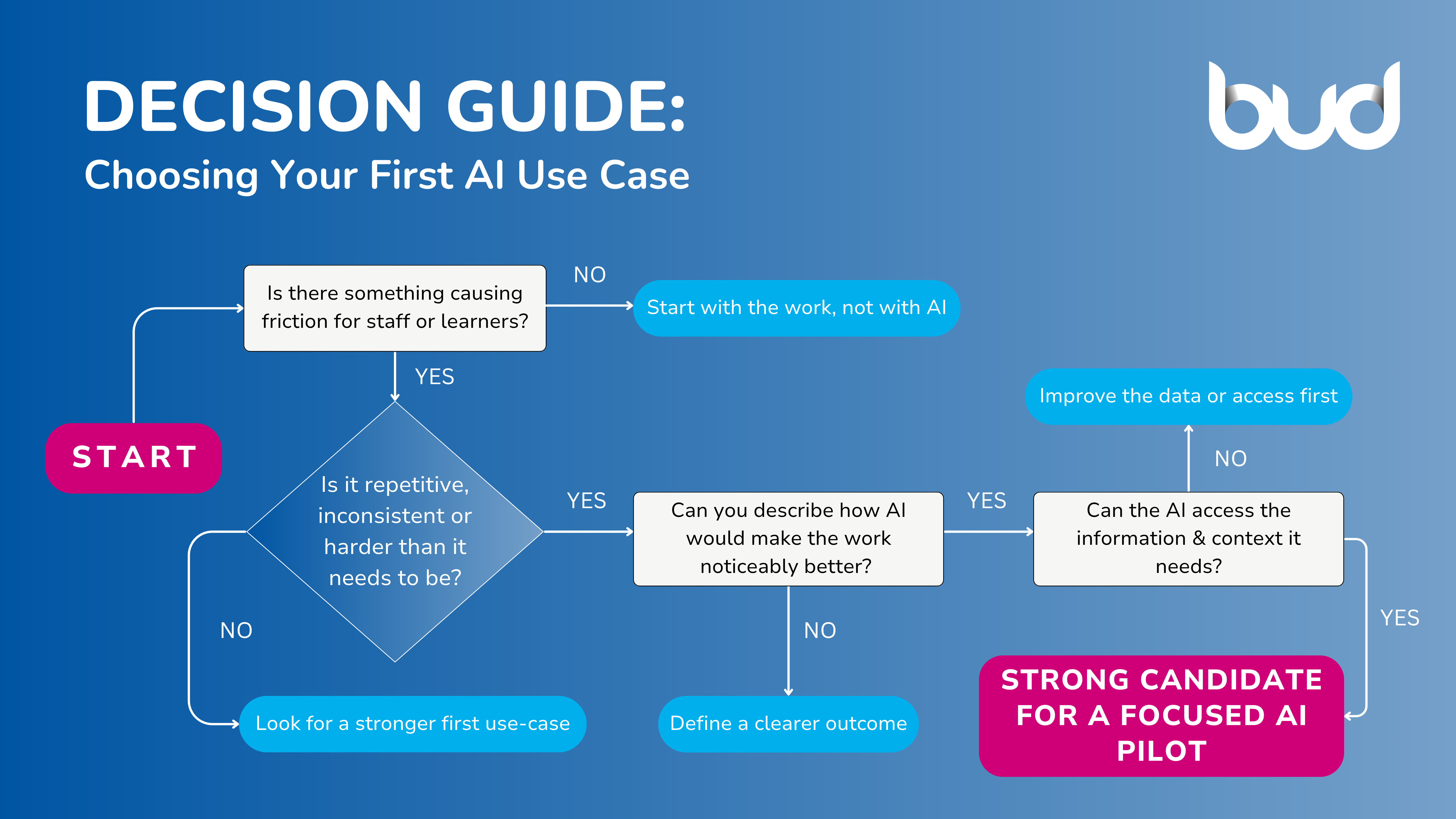
In this article: Identifying a practical first use case by focusing on a real problem, a clear outcome and work that genuinely matters. | 7 ...